
Regulation · August 2026 · Yamal Kalaf, Co-Founder, MiCAR Whitepapers Europe
This article is for informational purposes only. This article does not constitute legal advice. Before making decisions we advise to talk to a trusted advisor.
Token sales in the EU are governed by Article 4 of MiCAR, and the trigger is broader than most founders expect: an offer to the public is any communication, in any form, giving enough information on the terms and the token for a prospective holder to decide whether to buy[1]. The consequences are a whitepaper, a notification to a competent authority, publication, conduct duties and civil liability[2]. Exemptions exist for small, closed or professional offers, but they are narrower than they look, and every one of them collapses the moment a listing is announced[2]. This piece walks through what counts as an offer, what the exemptions really cover, how the analysis applies to self-hosted sales run on infrastructure like Sonar, and the traps that catch teams still running an ICO-era playbook.
Key takeaways
- MiCA does not use the word "ICO." Any communication presenting the terms of a token sale and enough information to decide can be an offer to the public under Article 3(1), point (12).
- The Article 4(2) exemptions (under 150 persons per member state, under EUR 1,000,000 over 12 months, qualified investors only) switch off the moment listing intentions are communicated (Article 4(4)).
- Hosting the sale yourself on your own domain, including Sonar-style self-hosted sales, changes nothing about the analysis. The sale page is the offer.
- Retail buyers now have a 14-day right of withdrawal when purchasing directly from the offeror, and cancelled offers must be refunded within 25 calendar days.
- Notification is not approval: the authority receives the whitepaper 20 working days before publication and supervises afterwards, which puts the liability squarely on the offeror. This makes it even more important for the offeror to ensure that his whitepaper is up to date and that all mandatory requirements are met.
The word "ICO" appears nowhere in MiCAR. The regulation replaced it with a defined term, the offer to the public, and built Title II around it. That is more than vocabulary. An initial coin offering was whatever the project said it was; an offer to the public is whatever meets the definition in Article 3(1), point (12), and the definition does not care what the sale is called, how it is dressed, or whether the word "sale" is used at all[1].
Since 30 December 2024 the rules attached to that term apply in full. A team planning a token sale into the EU is no longer choosing between doing an ICO and doing something compliant; it is deciding whether its communications meet a statutory definition, and if they do, the whitepaper machinery follows. The decision deserves more care than it usually gets, because both halves of it, the trigger and the exemptions, work differently from the folklore.
What counts as an offer to the public under MiCA?
The definition has three elements: a communication to persons, in any form and by any means, presenting sufficient information on the terms of the offer and the crypto-assets to be offered, so as to enable prospective holders to decide whether to purchase[1]. There is no minimum size, no requirement that the offer be open to everyone, and no requirement that it happen on a website. A launchpad page qualifies. So, on most fact patterns, does a presale pitch in a community channel, if it gives terms and enough substance to decide on.
The breadth is deliberate. The Prospectus Regulation uses the same technique for securities, and MiCAR imported the logic: regulate the communication that puts a purchase decision in front of the public, wherever it happens. What the definition does not capture is genuine silence. A team that deploys a token and says nothing to prospective EU purchasers has not, by that act alone, made an offer to the public, although the moment it seeks admission to trading, Article 5 brings the same whitepaper machinery in through the other door[2].
The checklist before receiving the first euro
Article 4(1) attaches seven conditions to offering a crypto-asset other than an ART or EMT to the public in the Union. The offeror must be a legal person; must have drawn up a whitepaper under Article 6; must have notified it to the competent authority of its home member state at least 20 working days before publication, and published it before the offer starts[3]; must have drafted and published any marketing communications to the Article 7 standard; and must comply with the conduct obligations of Article 14, which open with the duty to act honestly, fairly and professionally[2]. Behind the checklist sit the provisions this blog has covered before: the update duty of Article 12, the iXBRL format requirement in force since December 2025 under the ESMA taxonomy, and the civil liability of Article 15, which no disclaimer can contract away[5].
Notification is not approval. Article 8 says so in terms: competent authorities shall not require prior approval of whitepapers or marketing communications before publication[3]. The authority receives the filing and supervises afterwards, which makes a MiCAR offer faster to launch than a securities prospectus and moves the burden of getting the document right onto the offeror, exactly where the liability sits. Note also that a whitepaper supporting a public offer carries a materially heavier disclosure load than one filed for admission to trading alone: the offer-specific part of the template covers the fundraising targets, subscription terms, pricing and phases, targeted holders, safeguarding arrangements, payment and refund methods, costs and conflicts of the offer itself, all in the machine-readable formats the taxonomy prescribes. The notification also carries a classification explanation: the offeror must set out why the token is not an excluded asset such as a financial instrument, not an EMT and not an ART[3]. Classification analysis is not a preliminary nicety; it is a mandatory attachment.
MiCA whitepaper exemptions are narrower than they look
Article 4(2) exempts three categories of offer from the whitepaper obligations[2]:
- offers to fewer than 150 natural or legal persons per member state, acting on their own account;
- offers whose total consideration in the Union stays at or below EUR 1,000,000 over 12 months, counted from the start of the offer, including amounts raised in other currencies or in crypto-assets;
- offers addressed solely to qualified investors, where the token can only be held by qualified investors.
The fine print matters more than the list. The exemptions lift the whitepaper, notification and publication duties, but not everything else: the offeror must still be a legal person, marketing must still meet the Article 7 standard, and the Article 14 conduct obligations still apply[2]. The qualified-investor route requires the holding restriction to be real, not aspirational. And all of it rests on Article 4(4), the provision that undoes more plans than any other: the exemptions do not apply where the offeror, or anyone acting on its behalf, makes known in any communication an intention to seek admission to trading[2]. A "private round" announced together with a listing roadmap is not an exempt offer. One more trap deserves a sentence: draft a whitepaper voluntarily for an exempt offer, and Article 4(8) applies the whole Title to it anyway[2].
Offers outside Title II entirely
Article 4(3) takes four situations out of the Title altogether: tokens offered for free; tokens automatically created as rewards for maintaining the ledger or validating transactions; utility tokens giving access to a good or service that already exists or operates; and tokens usable only within a limited network of merchants under contract with the offeror[2]. Each carve-out has an edge. "Free" is defined honestly: a token is not free where purchasers hand over personal data, fees, commissions or any other benefit in exchange, which is precisely how most airdrop campaigns are built[2]. The existing-utility carve-out protects vouchers in token form, not roadmaps; where the good or service does not yet exist, the offer is not excluded, and Article 4(6) caps its duration at 12 months from publication of the whitepaper[2]. And the limited-network route stops being quiet above EUR 1,000,000 in a 12-month period: the offeror must then notify the competent authority, which can decide the network is not limited after all[2].
Self-hosted sales on Sonar: the ICO is back, the analysis is the same
The most visible development in token distribution this cycle is the return of the public sale in self-hosted form. Platforms like Sonar by Echo let a project run its subscription sale on its own domain: the project publishes a sale page with a fixed allocation, a price, a commitment window and minimum and maximum tickets, while the infrastructure underneath handles identity verification, jurisdiction gating and pro-rata settlement. Recent sales in this format follow a recognisable shape: a fixed round size, a defined subscription window, per-participant limits, verification before commitment, and, where the offer reaches EU purchasers, a MiCAR whitepaper notified and published for it.
Founders sometimes assume that self-hosting changes the regulatory position, on the theory that there is no launchpad intermediary and therefore no offer. The assumption runs exactly backwards. A sale page stating the token, the price, the window and the ticket sizes is the textbook Article 3(1), point (12) communication: terms plus enough information to decide. Hosting it on your own domain does not soften that conclusion; it removes any doubt about who the offeror is. If EU purchasers can commit, or the sale is promoted to them, the offer is being made in the Union and Article 4 applies to the project itself.
Four features of the Sonar format deserve specific attention.
Round sizing and the EUR 1,000,000 exemption. Self-hosted rounds are often sized in the low millions, which puts them near the Article 4(2)(b) threshold. Three details decide whether the exemption actually holds. The threshold counts consideration in the Union, not the global raise, so jurisdiction gating determines the relevant number. It counts everything of value over 12 months, including stablecoins and other crypto-assets, at the applicable conversion. And it survives only as long as Article 4(4) is respected: the moment the project, or anyone acting for it, communicates an intention to seek admission to trading, the exemption is gone. A sale page that mentions exchange listings, trading release of locked tokens, or a token generation event followed by secondary markets has usually made that communication already. In practice, most self-hosted sales that intend to list should treat the exemption route as closed and plan for a whitepaper from the start.
Marketing before the whitepaper. A strict interpretation of Article 7(2) prohibits disseminating marketing communications before the whitepaper is published where one is required[2]. The announcement thread, the backers graphic and the sale countdown are marketing communications in the Article 7 sense: they must be identifiable as marketing, fair, clear, not misleading and consistent with the whitepaper, and they cannot precede it. For a self-hosted sale the practical sequencing is therefore fixed: classification analysis, whitepaper, notification 20 working days ahead, publication, and only then the campaign.
However, it is our opinion that this should not be interpreted too strictly. It is normal for an offeror to announce that a sale will commence on a specified date, and offerors should be able to communicate in general terms that the token will be offered. In particular, a general announcement that is not specifically targeted at Europe should not, in our view, automatically be considered prohibited marketing communication.
Similarly, a pre-registration process should be possible, provided that prospective buyers can express their interest on a non-binding basis only. Where no payment is required or accepted, and the registration does not constitute a commitment to purchase the tokens, it should be possible to allow interested persons to register to receive a notification when the offer commences.
Lock-up tiers and equal treatment. A common Sonar-era mechanic is tiered pricing, for instance a discounted price with a lock-up against a higher price without one. Article 14(2) requires holders to be treated equally unless the preferential treatment and the reasons for it are disclosed in the whitepaper[3]. Tiered pricing is workable, but it is a disclosure item, not a private design choice. The same goes for any allocation preferences given to earlier communities or backers.
Commitments, custody and the right of withdrawal. A subscription sale collects funds during a window and settles pro-rata afterwards, which brings two often-missed provisions into play. Article 10(3) requires funds or crypto-assets raised during a time-limited offer to be safeguarded in custody with a credit institution or a CASP providing custody, an obligation that an on-chain commitment contract does not satisfy by itself and that needs to be designed into the flow[2]. And Article 13 gives retail purchasers buying directly from the offeror a 14-day right of withdrawal, without fees and without reasons, which cannot be exercised after the subscription period closes but is live during it[4]. A commitment locked in a smart contract does not extinguish a statutory right; the refund mechanics have to be able to honour it. The obligations also outlast the window: Article 10 requires an offeror that set a time limit to publish the result of the offer on its website within 20 working days of the end of the subscription period, and an offeror running an open-ended offer to publish, at least monthly, the number of tokens in circulation[2]. A pro-rata settlement page that already shows total commitments is most of the way there, but the publication duty is the offeror's, on its own website, and it belongs in the launch plan next to distribution. Projects running audited sale contracts already understand the value of running smart contract audit and disclosure as one workstream, and the withdrawal, refund and post-offer publication mechanics belong in that same combined design conversation.
None of this makes the self-hosted format unattractive. The opposite is true: a sale run on the project's own domain, with verification gating jurisdictions, a notified whitepaper and disclosed tiering, is one of the cleanest ways to run a compliant public distribution in the EU. The format works precisely because it takes the offer seriously instead of pretending there is not one.
What buyers get that ICO buyers never had
The clearest break with the ICO era is Article 13. Retail purchasers who buy directly from the offeror, or from a CASP placing the tokens on its behalf, have 14 calendar days to withdraw from the purchase, without fees and without giving reasons, counted from the date of the purchase agreement[4]. Reimbursement must follow within 14 days, by the same means of payment. The right ends where secondary trading begins: it does not apply to tokens already admitted to trading before the purchase, and where the offer runs on a subscription period, it cannot be exercised after that period closes[4]. The whitepaper must state the right in terms, which means an offeror's subscription flow, treasury planning and refund mechanics have to assume that some of the raise can walk back out. The withdrawal right sits alongside a broader set of refund events that the whitepaper has to describe: purchasers are also entitled to reimbursement where a minimum subscription goal set for the offer is not reached by its close, and where the offer is cancelled. Article 14 adds two protections of its own: where an offer is cancelled, all funds collected must be returned within 25 calendar days, and holders must be treated equally, with preferential treatment of specific holders, a discounted presale tier for instance, permitted only where it and the reasons for it are disclosed in the whitepaper[3]. ICO proceeds were final the moment they arrived. MiCAR proceeds are provisional for two weeks.
Reading it as a founder
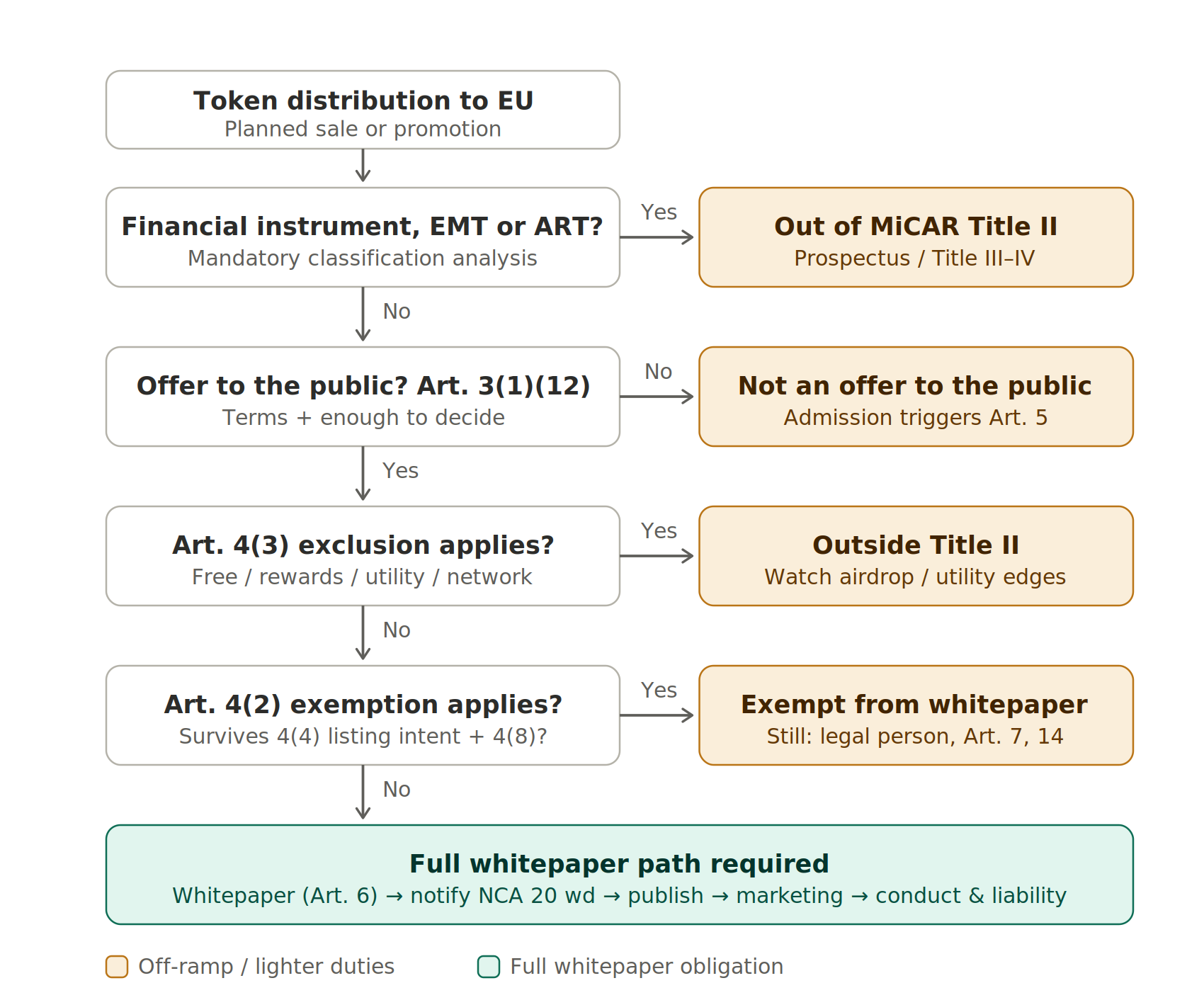
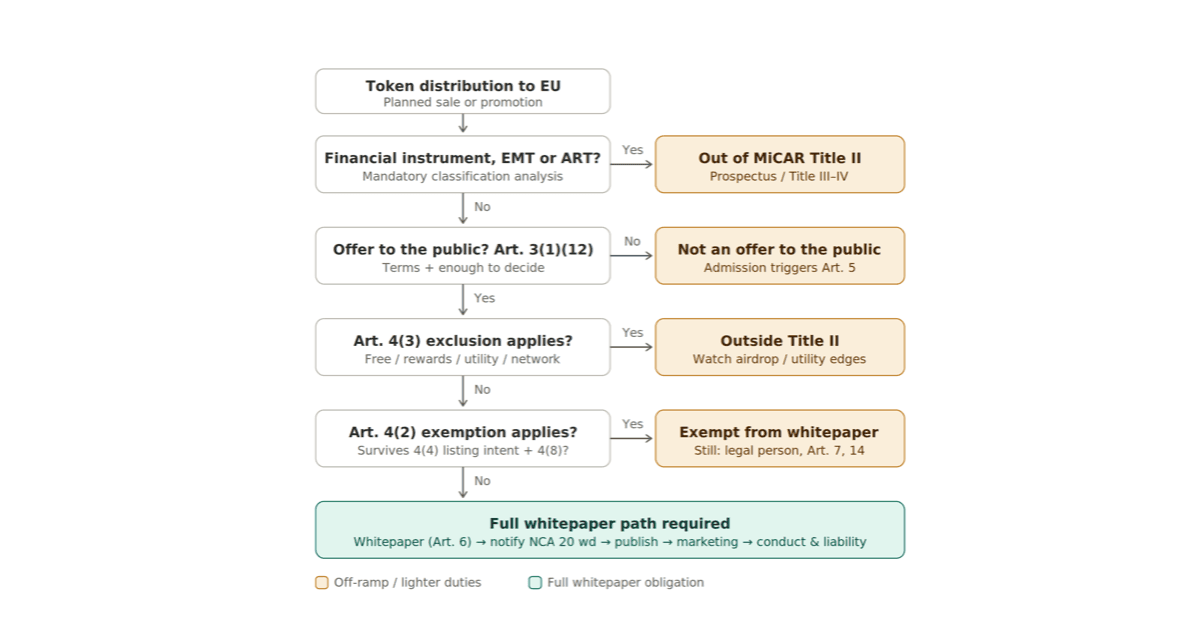
The decision path is short, and it rewards being run in order. First, does the planned communication meet the definition, terms plus enough information to decide? If yes, second: does one of the Article 4(3) exclusions apply on the actual facts, not on the pitch-deck version of them? Third, if not excluded, does an Article 4(2) exemption fit, and does it survive the listing plan, remembering that announcing admission intentions switches the exemptions off? Fourth, if the answer is a whitepaper, and for a self-hosted sale with listing ambitions it almost always is, the same document can carry subsequent offers and later listings, since a compliant, updated whitepaper can be reused with the written consent of the person who drew it up[2]. Classification still comes before all of this: a token that qualifies as a financial instrument leaves MiCAR for the prospectus regime entirely, which is a different article and a different budget.
Title II, including the offer regime, is one of the areas under assessment in the 2026 MiCA review consultation, open until 30 September 2026, so the settings described here may move in time[6]. The obligations as they stand apply in full, and an offer built cleanly against them, definition checked, exemption documented or whitepaper filed, is cheaper than any version of finding out mid-raise. A well-prepared whitepaper does not guarantee a smooth offer, but it can reduce, though not eliminate, the ways an offer goes wrong.
Frequently asked questions
Are ICOs legal in the EU under MiCA?
Yes, but not under that name or the old rules. A token sale to EU purchasers is an offer to the public under MiCA Title II, which requires a legal-person offeror, a notified and published whitepaper, compliant marketing and adherence to conduct and liability rules, unless a specific exemption or exclusion applies.
Does a self-hosted Sonar sale need a MiCA whitepaper?
If EU purchasers can participate or the sale is promoted to them even if this happens indirectly, the sale page itself is an offer to the public and the whitepaper obligations apply to the project as offeror. Running the sale on your own domain does not change the analysis, and communicated listing intentions disable the small-offer exemptions.
What are the MiCA whitepaper exemptions for token sales?
Article 4(2) exempts offers to fewer than 150 persons per member state, offers up to EUR 1,000,000 in the Union over 12 months, and offers solely to qualified investors who alone can hold the token. All three fall away if an intention to seek admission to trading is communicated, and conduct and marketing rules continue to apply regardless.
Do token sale buyers have a refund right under MiCA?
Retail purchasers buying directly from the offeror, or through a CASP placing on its behalf, have a 14-day right of withdrawal without fees or reasons. It does not apply to tokens already admitted to trading, and in a time-limited offer it cannot be exercised after the subscription period ends.
How long before a token sale must the whitepaper be notified?
At least 20 working days before publication, to the competent authority of the home member state, and the whitepaper must be published before the offer starts. Notification is not approval: the authority does not pre-approve the document, and responsibility for its contents stays with the offeror.
MiCAR Whitepapers Europe helps token projects decide whether an offer to the public is in play, documents the exemption analysis when it is not, and drafts and notifies the whitepaper when it is, including for self-hosted Sonar sales. Our whitepaper drafting, MiCAR notification and iXBRL conversion services cover the full path from classification to a published, compliant offer. If you are planning a token sale with Europe on the map, contact us at info@micarwhitepapers.eu, on Telegram at @micar_whitepapers, or through the Get started form at micarwhitepapers.eu.
Yamal Kalaf, Co-Founder, MiCAR Whitepapers Europe
References
- 1. Regulation (EU) 2023/1114 of the European Parliament and of the Council of 31 May 2023 on markets in crypto-assets (MiCAR), Article 3(1), point (12) (definition of 'offer to the public'), OJ L 150, 9.6.2023 (EUR-Lex).
- 2. Regulation (EU) 2023/1114 (MiCAR), Articles 4, 5, 7 and 10 (offers to the public; admission to trading; marketing communications; result of the offer and safeguarding arrangements), including Article 4(2) to (8) (EUR-Lex).
- 3. Regulation (EU) 2023/1114 (MiCAR), Articles 8, 9 and 14 (notification and publication of the crypto-asset white paper; obligations of offerors and persons seeking admission to trading) (EUR-Lex).
- 4. Regulation (EU) 2023/1114 (MiCAR), Article 13 (right of withdrawal) (EUR-Lex).
- 5. Regulation (EU) 2023/1114 (MiCAR), Articles 12 and 15 (modification of published white papers; liability for the information given in a white paper) (EUR-Lex); ESMA, iXBRL taxonomy for crypto-asset white papers, applicable from 23 December 2025, esma.europa.eu.
- 6. European Commission, Consultation document: Targeted consultation on the review of the Regulation on the Markets in Crypto-Assets (MiCA), 20 May 2026; the response deadline has been extended to 30 September 2026 (finance.ec.europa.eu).