
Regulation · August 2026 · Yamal Kalaf, Co-Founder, MiCAR Whitepapers Europe
This article is for informational purposes only. This article does not constitute legal advice. Before making decisions we advise to talk to a trusted advisor.
Most discussion of MiCAR whitepapers assumes an issuer: a project raising money, drafting a disclosure document, notifying a competent authority. Title II has a second door, and it opens onto crypto-asset service providers. Where a token is admitted to trading on a platform, Article 5 makes a compliant whitepaper a condition of admission, and on several routes the duty to produce that document lands on the operator rather than the project. It is the same whitepaper machinery as a public offer, pointed at a different party.
For platforms with a catalogue inherited from before MiCAR applied, this is not a theoretical problem. It is a dated one, and the date is 31 December 2027.
Key takeaways
- Three routes put a whitepaper duty on a trading platform: admission on the operator's own initiative under Article 5(2), a written transfer of drafting from the person seeking admission under Article 5(3), and the legacy-catalogue obligation in Article 143(2).
- Legacy tokens, meaning those admitted to trading before 30 December 2024, must have a whitepaper drawn up, notified, published and kept up to date by 31 December 2027, in the cases where the regulation requires one.
- ESMA Q&A 2654 did not create a general exemption for offerors. It addresses tokens already admitted before 30 December 2024 and moves that duty to platform operators; an ongoing or new offer takes the ordinary Article 4 route in full.
- Crypto-assets with no identifiable issuer sit outside Title II per the Commission's answer to Q&A 2552, but the platform still has to reach and document that conclusion as part of its suitability assessment.
- Reusing a whitepaper needs the written consent of the person who drew it up. Publishing a hyperlink to it under Article 66(3) needs no consent at all. The two duties are routinely conflated.
Three routes to a whitepaper duty on a platform
The starting position is unremarkable: the person seeking admission to trading draws up the whitepaper, notifies it and publishes it, in the same way an offeror does for a public offer. What makes Article 5 interesting for CASPs is what happens when there is no such person, or when the parties agree otherwise.
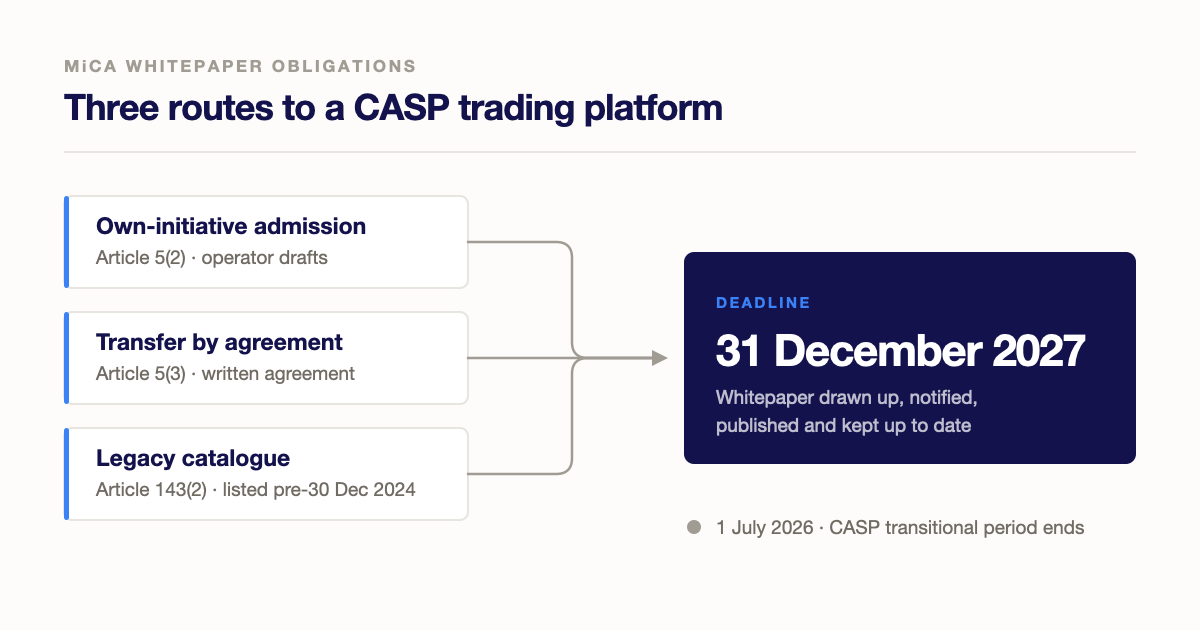
Own-initiative admission. Where the operator of the trading platform admits a crypto-asset on its own initiative, and no whitepaper has already been published in the cases the regulation requires one, the operator itself must meet the admission requirements. There is no counterparty to carry the obligation, so the platform drafts, notifies and publishes, and stands behind the document afterwards. The qualifier matters in practice: if a compliant whitepaper already exists for the asset, own-initiative admission does not manufacture a second drafting duty.
Transfer by written agreement. Where there is a person seeking admission, that person and the operator may agree in writing that the operator prepares the whitepaper instead. The transfer can cover all or part of the requirements, and the agreement has to state clearly that the person seeking admission will supply the operator with all the information it needs to satisfy them. The drafting moves; the underlying information does not, and neither does all of the liability.
Operating rules. Separately from either route, an operator's rules of operation must provide that a crypto-asset is not admitted where a whitepaper is required and has not been published. This is the mechanism that turns the obligation into a listing gate rather than a filing afterthought.
"2. When a crypto-asset is admitted to trading on the initiative of the operator of a trading platform and a crypto-asset white paper has not been published in accordance with Article 9 in the cases required by this Regulation, the operator of that trading platform for crypto-assets shall comply with the requirements set out in paragraph 1 of this Article."
"3. By way of derogation from paragraph 1, a person seeking admission to trading ... and the respective operator of the trading platform may agree in writing that it shall be the operator of the trading platform who is required to comply with all or part of the requirements referred to in paragraph 1, points (b) to (g)."
Who drafts, who is liable
Drafting and liability are not the same allocation, and the difference is where platforms get caught out. Under Article 15, the person seeking admission, or the operator where it drew up the document, is liable for the information in the whitepaper, together with the members of its management body. A disclaimer purporting to exclude that liability has no legal effect. Where drafting was transferred by agreement, the person seeking admission does not walk away: it remains responsible for information it supplied that was incomplete, unfair, unclear or misleading.
"The person seeking admission to trading should remain responsible when it provides misleading information to the operator of the trading platform. The person seeking admission to trading should also remain responsible for matters not delegated to the operator of the trading platform."
| Route | Who drafts | Who carries Article 15 liability | Deadline |
|---|---|---|---|
| Own initiative Article 5(2) |
The operator | The operator and its management body | Before admission |
| Transfer by agreement Article 5(3) |
The operator, by written agreement | The operator for the document; the person seeking admission where it supplied misleading information, and for matters not delegated to the operator | Before admission |
| Legacy catalogue Article 143(2) |
The operator ensures one exists | Whoever draws the document up, on the ordinary Article 15 allocation | 31 December 2027 |
The practical reading for an operator running the Article 5(3) route: the written agreement is not a liability transfer, it is a drafting arrangement with a liability split attached. What protects the platform is not the contract but the quality of the information package it received, and its own record of what it did with that package.
The 31 December 2027 deadline for legacy catalogues
Article 143(2) is the transitional provision that catches everything listed before the regime began. For crypto-assets other than ARTs and EMTs that were admitted to trading before 30 December 2024, operators of trading platforms must ensure that a whitepaper is drawn up, notified, published and kept up to date by 31 December 2027, in the cases where the regulation requires one.
"2. By way of derogation from Title II, only the following requirements shall apply in relation to crypto-assets other than asset-referenced tokens and e-money tokens that were admitted to trading before 30 December 2024:
(a) Articles 7 and 9 shall apply to marketing communications published after 30 December 2024;
(b) operators of trading platforms shall ensure by 31 December 2027 that a crypto-asset white paper, in the cases required by this Regulation, is drawn up, notified and published in accordance with Articles 6, 8 and 9 and updated in accordance with Article 12."
- 30 December 2024 MiCAR Title II applies in full. Tokens admitted to trading before this date form the legacy catalogue.
- 23 December 2025 The machine-readable format requirement applies: whitepapers are prepared in iXBRL under the ESMA taxonomy.
- 1 July 2026 The Article 143(3) transitional period ends for providers that were operating under national law, or earlier if authorisation is granted or refused first. Member States could shorten it further.
- 31 December 2027 Legacy-catalogue deadline: whitepaper drawn up, notified, published and kept up to date.
Two details in the same provision are easy to miss. Article 143(2)(a) keeps the marketing rules alive for the legacy population: Articles 7 and 9 apply to any marketing communication published after 30 December 2024, whitepaper or no whitepaper. And Article 143(1) disapplies Articles 4 to 15 to offers to the public that ended before 30 December 2024, which is a separate carve-out from the admission one and is often quoted as though it covered both.
ESMA addressed the allocation directly in a Q&A published on 14 October 2025. For tokens in that legacy population, offerors and persons seeking admission carry no whitepaper duty, and the obligation sits with the operator of the trading platform. Read narrowly, that is a sensible answer to a real problem: many pre-2025 listings have no cooperative counterparty, and some have no counterparty at all.
After Q&A 2654, a misreading circulated: that offerors in general were now exempt from Article 4 until 2028. The Q&A says no such thing. The relief in Article 143(2) attaches to one situation only, tokens admitted to trading before 30 December 2024, and the duty it defers lands on operators of trading platforms, not on offerors. An offer to the public that is ongoing, or made today, takes the ordinary Article 4 route in full, whatever the token's listing history. Any launch plan built on the broader reading is built on a provision that does not exist.
Triaging a legacy catalogue
For a platform with hundreds of listed assets, 31 December 2027 is not a filing deadline, it is a programme. The work is triage before it is drafting, and the order of the questions decides how much drafting there turns out to be.
Legacy triage, in order
- Is a whitepaper required at all? Article 143(2) applies only in the cases the regulation requires one. This is where the identifiable-issuer test below sits, alongside the ordinary exclusions.
- Does a compliant document already exist elsewhere, and is consent available? A whitepaper notified for another EU platform can be relied on, but only with the written consent of the person who drew it up.
- If not, who drafts? The project, the platform on its own initiative, or a third party under a written agreement.
- On what information package, and in what format? Everything filed from 23 December 2025 goes in as an iXBRL document, which means the information has to be structured, not merely written.
Tokens without an identifiable issuer
The first triage question got a firmer answer in February 2026, when the Commission's answer to Q&A 2552 was published. Article 5(2) does not reach crypto-assets that have no identifiable issuer: recital 22 places them outside Title II, so no whitepaper is required for them under MiCAR, and the operator's own-initiative drafting duty does not arise. The same qualifier, "in the cases required by this Regulation", runs through Articles 76(1) and 143(2)(b), so the legacy-catalogue deadline inherits the carve-out too.
"This Regulation covers the rights and obligations of issuers of crypto-assets, offerors, persons seeking admission to trading of crypto-assets and crypto-asset service providers. Where crypto-assets have no identifiable issuer, they should not fall within the scope of Title II, III or IV of this Regulation. Crypto-asset service providers providing services in respect of such crypto-assets should, however, be covered by this Regulation."
The carve-out is narrower in practice than in summary. The platform is not relieved of its suitability assessment, and determining whether an identifiable issuer exists is part of that assessment, a documented conclusion rather than a default setting. Our expectation is that competent authorities will read "no identifiable issuer" strictly: most tokens have one, even where it has not yet been identified at admission, and a triage file that stamps half a catalogue "no issuer" without analysis will read as avoidance, not classification. Treat the no-issuer conclusion as an exception that must earn its place in the file.
Reuse, consent and the Article 66(3) hyperlink
A token listed on one EU platform does not need a fresh whitepaper for the next one. Article 5(4) switches off the drafting, notification and publication requirements where the crypto-asset is already admitted to trading on another trading platform in the Union and the existing whitepaper was drawn up under Article 6, updated under Article 12, and the person responsible for drawing it up consents in writing to its use. All three conditions have to hold; the consent is the one that gets forgotten.
Reusing a whitepaper, meaning relying on it for a further admission or a subsequent offer, requires the written consent of the person who drew it up. Publishing a hyperlink to it under Article 66(3) requires no consent at all. Platforms need the consent letter in the listing file; a CASP providing one of the four services listed in Article 66(3) just needs the link. Conflating the two either overburdens the link duty or, worse, treats a hyperlink as a substitute for the consent the reuse actually requires.
Article 66(3) is a transparency duty attached to the service, not to the document, and it is narrower than "every CASP": it bites when operating a trading platform, exchanging crypto-assets for funds or other crypto-assets, advising on crypto-assets, or providing portfolio management. A CASP doing only custody or transfer services is not caught by the hyperlink duty. For those that are, it is cheap to comply with and easy to forget at scale, because it applies across the catalogue rather than at the moment of listing.
"When operating a trading platform for crypto-assets, exchanging crypto-assets for funds or other crypto-assets, providing advice on crypto-assets or providing portfolio management on crypto-assets, crypto-asset service providers shall provide their clients with hyperlinks to any crypto-asset white papers for the crypto-assets in relation to which they are providing those services."
The format requirement: everything arrives as iXBRL
Since 23 December 2025, a MiCAR whitepaper is filed as an iXBRL filing, tagged against the ESMA taxonomy, under the technical standards in Implementing Regulation (EU) 2024/2984. For a platform planning a legacy programme this is a production constraint, not a footnote: several hundred documents cannot be tagged by hand in the last quarter of 2027.
The format requirement has a timing question of its own: what about whitepapers notified before 23 December 2025, when the ITS began to apply? Our position is that the prudent course, and in our reading the intended one, is conversion. The ITS applies "as of" that date, language that attaches to the population of whitepapers from that date forward rather than only to new filings, and the stated purpose of the standard, comparability and machine-readable supervision across the market, is defeated if the earliest filings remain permanently outside it. There is also a mechanical forcing point: any Article 12 modification notified after the application date has to be filed to the standard in any event, so a maintained whitepaper converges on iXBRL at its first update. Converting on your own schedule is cheaper than converting on a deadline set by a material change. ESMA's implementation statement is the reference point for how supervisors expect the transition to be handled.
When the CASP is the offeror
One scenario runs in the opposite direction from everything above: instead of the whitepaper duty reaching the platform through Article 5, it reaches the CASP through Article 4, because the CASP's own service amounts to an offer. ESMA's statement on non-compliant ARTs and EMTs made the mechanism explicit for stablecoins: services such as reception and transmission of orders, execution of orders, and exchange of crypto-assets for funds or other crypto-assets can themselves constitute an offer to the public. The logic is not confined to stablecoins. The Article 3(1), point (12) definition is deliberately broad, a communication presenting the terms and enough information to decide, and whether a given exchange or brokerage service crosses it is a case-by-case assessment, not a licensing category.
The practical consequence for CASPs: the whitepaper analysis is not finished when the Article 5 admission questions are answered. A service that presents specific tokens to clients on terms they can act on may be making an offer to the public in its own right, with the Article 4 machinery, legal-person offeror, whitepaper, notification, marketing standard, conduct duties, attaching to the CASP as offeror.
Supervisory context
None of this is happening in a settled framework. Title II is one of the areas under assessment in the 2026 MiCA review consultation, open until 30 September 2026, and the Commission's report is due by 30 June 2027, six months before the legacy deadline falls. Platforms should plan on the rules as they stand: a review that reports in mid-2027 cannot realistically move a deadline at the end of it.
The population subject to these duties keeps growing. The ESMA register listed 322 authorised crypto-asset service providers across 26 Member States when we consulted it in August 2026, up from around 170 at the time of the Commission's consultation document in May, with the transitional period for providers operating under national regimes having ended on 1 July 2026. Every one of those authorisations that includes operating a trading platform brings a catalogue with it.
What platforms and projects should do
For operators, the sequence is inventory, triage, then production. Inventory means a definitive list of admitted assets with their admission dates, because 30 December 2024 divides the catalogue into two different legal populations. Triage means running the four questions above per asset and writing down the answer, including for the assets you conclude need nothing. Production means deciding, per asset, whether the project drafts, you draft, or you contract it out, and building an iXBRL pipeline that can carry the volume.
For projects listed on EU platforms, the point to take is that Article 143(2) is relief from a duty, not from an interest. If your token is in a platform's legacy catalogue, someone is going to draft a disclosure document about your project before the end of 2027, and if it is not you, it will be written from the outside on whatever information the platform can assemble. Volunteering the information package, and the consent, is usually the better outcome.
The deadline looks distant. It is two triage cycles and one drafting programme away, and the first of those is the one nobody schedules.
Frequently asked questions
Do CASPs have whitepaper obligations under MiCA?
Yes. An operator that admits a token on its own initiative must itself meet the admission requirements, including drafting, notifying and publishing the whitepaper. Operators can also take over drafting from the person seeking admission by written agreement under Article 5(3), and operating rules must state that no token is admitted without a required whitepaper.
What is the MiCA whitepaper deadline for legacy tokens?
31 December 2027. For tokens admitted to trading before 30 December 2024, Article 143(2) requires operators of trading platforms to ensure a whitepaper is drawn up, notified, published and kept updated by that date, in the cases where the regulation requires one.
Did ESMA Q&A 2654 exempt offerors from the whitepaper requirement?
No. The Q&A confirms that for tokens admitted to trading before 30 December 2024, offerors and persons seeking admission carry no whitepaper duty and the 2027 obligation sits with platform operators. It creates no general exemption: an ongoing or new offer to the public takes the ordinary Article 4 route in full.
Does a token without an identifiable issuer need a MiCA whitepaper?
No, per the Commission's answer to Q&A 2552, crypto-assets with no identifiable issuer fall outside Title II, so no whitepaper is required and the operator's own-initiative drafting duty does not arise. The platform must still assess suitability, and determining whether an identifiable issuer exists is part of that assessment.
Can an exchange or broker be an "offeror" under MiCA?
Yes, on the right facts. ESMA has confirmed that services like exchange of crypto-assets for funds or other crypto-assets, and reception, transmission or execution of orders, can themselves constitute an offer to the public. Whether they do is a case-by-case assessment against the broad Article 3(1), point (12) definition.
Who is liable for an operator-drafted whitepaper?
The operator that draws up the whitepaper stands behind it under Article 15(1), together with its management body; disclaimers of that liability have no legal effect. Where drafting was transferred by agreement, the person seeking admission remains responsible for information it supplied that was incomplete, unfair, unclear or misleading.
Can a token be listed on a second exchange without a new whitepaper?
Yes. Article 5(4) disapplies the drafting, notification and publication requirements where the token is already admitted to trading on another EU trading platform and the existing whitepaper was drawn up under Article 6, updated under Article 12, and the person who drew it up consents in writing to its use. Publishing a hyperlink under Article 66(3) requires no consent; relying on the document does.
Do whitepapers filed before 23 December 2025 need to be converted to iXBRL?
The ITS applies "as of" 23 December 2025, and in our view the prudent reading is that maintained whitepapers should be brought to the standard, at the latest at their first Article 12 modification, which must be filed to the standard in any event.
MiCAR Whitepapers Europe works with trading platforms on legacy-catalogue triage and with projects on the documents that come out of it. Our whitepaper drafting, MiCAR notification and iXBRL conversion services cover the full path from classification to a published, machine-readable filing. If you are mapping a catalogue against the 2027 deadline, contact us at info@micarwhitepapers.eu, on Telegram at @micar_whitepapers, or through the Get started form at micarwhitepapers.eu.
Yamal Kalaf, Co-Founder, MiCAR Whitepapers Europe
References
- 1. Regulation (EU) 2023/1114 (MiCAR), in particular Article 5 (including 5(2), 5(3) and 5(4)), Articles 4, 6, 7, 9, 12 and 15, Article 66(3), Article 76(1), Article 143(1), (2) and (3), and recitals 22 and 32, OJ L 150, 9.6.2023 (EUR-Lex).
- 2. ESMA, Q&A 2654 on white paper obligations for crypto-assets admitted to trading before 30 December 2024, published 14 October 2025, esma.europa.eu.
- 3. European Commission, answer to Q&A 2552 on crypto-assets without an identifiable issuer, published February 2026, esma.europa.eu.
- 4. ESMA, Statement to support the smooth implementation of MiCA standards and format (ESMA75-1303207761-6284), November 2025, esma.europa.eu.
- 5. ESMA, Statement on non-compliant asset-referenced tokens and e-money tokens (ESMA75-223375936-6099), January 2025, esma.europa.eu.
- 6. Commission Implementing Regulation (EU) 2024/2984 of 29 November 2024 laying down implementing technical standards for the standard forms, formats and templates for crypto-asset white papers, applicable as of 23 December 2025 (EUR-Lex).
- 7. European Commission, Targeted consultation on the review of the MiCA Regulation, 20 May 2026, response deadline extended to 30 September 2026, finance.ec.europa.eu.
- 8. ESMA register of authorised crypto-asset service providers under MiCAR (CSV), which listed 322 authorised entities across 26 Member States when consulted in August 2026, esma.europa.eu.